Looking Under Stones by Joe O'Toole
Author:Joe O'Toole [O'Toole, Joe]
Language: eng
Format: epub
ISBN: 9781847175182
Publisher: The O'Brien Press
Published: 2012-06-15T04:00:00+00:00
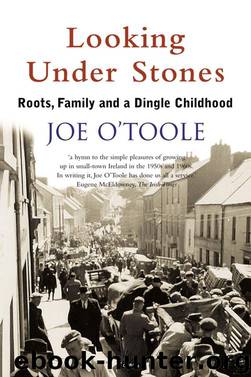
As well as the buying and selling, which was the main business of the fair, there were numerous hangers-on and diversions: hucksters, stall-holders, spongers and the inevitable fights that broke out when drink was taken and old scores were resurrected. I’d be looking for any excuse to leave Uncle Benny and wander around the stalls that displayed wares from all over the world. There were sets of cheap Japanese screwdrivers that fit snugly into each other, bicycle pumps, hammers and an ingenious, multi-size German spanner, which, it was claimed, would fit every nut on a bicycle. The clothes stall was festooned with woollen drawers, trousers and rolls of material. And, inevitably, there was the loud guy shouting and roaring at people to buy ‘the best delph at give away prices’. I was always wary of getting too close to him.
In those days Dingle was not equipped to meet the needs of tourism or travellers. There were no restaurants or cafés, not even a sandwich for sale. There was, of course, Benners’ Hotel, but that was strictly the preserve of commercial travellers, visiting dignatries and wealthy foreign tourists, and definitely off-limits to ordinary folk. Country people in town for the day’s shopping had to rely on the welcome of relatives or the hospitality of shopkeepers to get a mug of tea or a bite to eat. But there was one exception: Fair Day. On that one day in the month, McKenna’s in the Dykegate Lane sold tea and sandwiches, and Griffin’s Pie Shop on Main Street opened for the sale of Dingle pies. A Dingle pie had the look of a steak-and-kidney pie about it except that it was filled with mutton, and served in a large soup dish swimming in mutton broth. The hot, steaming plates of Dingle pies were a huge attraction on Fair Day. As they say, there was ‘’atin’ and drinkin’’ in them. No wonder there was a queue of customers out the door and down the street by the time the shop opened in the late morning of a fair day.
On the afternoon of Fair Day, my grandmother was at her busiest and I was under instructions to be available to her as soon as I had finished with Uncle Benny – to run messages to the tailor’s, to help customers with their shopping, or to search the pubs for their errant husbands. Like my mother, Bridgy Fitz went by her maiden name; their married titles were only ever used by polite strangers or ‘blow-ins’. Bridgy Fitz’s tiny shop would be teeming with customers. Suits of clothes ordered, wellington boots sold, caps and hats being fitted, Confirmation and First Communion outfits being readied. It was non-stop. Men were involved only when it was an item of attire that required them to be present and even then they were reluctant and reticent participants. Rolls of cloth were laid out on the counter – navy, brown, dark grey with a bit of a line running through it, but nothing flashy.
Download
This site does not store any files on its server. We only index and link to content provided by other sites. Please contact the content providers to delete copyright contents if any and email us, we'll remove relevant links or contents immediately.
| Africa | Americas |
| Arctic & Antarctica | Asia |
| Australia & Oceania | Europe |
| Middle East | Russia |
| United States | World |
| Ancient Civilizations | Military |
| Historical Study & Educational Resources |
Room 212 by Kate Stewart(5129)
The Crown by Robert Lacey(4818)
Endurance: Shackleton's Incredible Voyage by Alfred Lansing(4786)
The Iron Duke by The Iron Duke(4365)
The Rape of Nanking by Iris Chang(4218)
Joan of Arc by Mary Gordon(4116)
Killing England by Bill O'Reilly(4006)
Say Nothing by Patrick Radden Keefe(3990)
I'll Give You the Sun by Jandy Nelson(3450)
Shadow of Night by Deborah Harkness(3372)
Hitler's Monsters by Eric Kurlander(3346)
Mary, Queen of Scots, and the Murder of Lord Darnley by Alison Weir(3213)
Blood and Sand by Alex Von Tunzelmann(3206)
Eleanor & Park by Rainbow Rowell(3181)
Darkest Hour by Anthony McCarten(3134)
Margaret Thatcher: The Autobiography by Thatcher Margaret(3085)
Book of Life by Deborah Harkness(2941)
Red Famine: Stalin's War on Ukraine by Anne Applebaum(2939)
The One Memory of Flora Banks by Emily Barr(2868)
